Back Light
Shooting against the sun(light) is usually avoided when doing infrared photography. Flare, uneven exposure and discoloration are caveats of shooting IR back light (against the sun). IR photos with sun 'behind' are generally more admirable. However, you can always break the rules and try 'back lighting' in infrared photography. Here are a few shots with the sun partially covered by structures or foliage. All photos here were taken with a Nikon D70s-D70 combo body converted to 'infrared color enhance' together with a Sigma 10-20 Dx Lens.
An image in Raw:
Monochrome:
Same image cropped and in color.
A different perspective.
Another example of an IR shot back-lighted.
Showing posts with label composition. Show all posts
Saturday, June 23, 2012
Wednesday, May 30, 2012
Wide Lens Perspective
Using wide angle lens for infrared photography not only allows you to shoot wide angle viewpoints but also use the wide lens perspective in different creative ways. When you use a wide angle lens such as a 10 millimeter lens for cropped sensor or 16 millimeter lens for a full frame camera, you can have an amazing wide point of view but when pointing the camera vertically up or down, you get weird but interesting distortions.
For example, this wide angle shot taken from below pointing up, demonstrates how the ledges and the vertical supports seem to bend towards the middle of the frame. Bizarre but absorbing and entertaining distortion created by the wide lens perspective.
Here is another perspective, albeit showing more of the architecture, from the same location:
Again, wide angle lenses can contain as many elements as possible but you do not have to include everything in a frame just because a wide angle lens can do so. In the next image below, the infrared photograph in raw format shows how too much can sometimes become overpowering. This photo can work as a documentary infrared shot, showing the overall view of a scene. The diagonal lines from the lower half of the frame, seemingly converge, leading the viewer’s eye towards the center of the image. The rooftop of the other structures also create diagonal lines. The caveat here, is that too many elements were included in the frame and simplifying the image might be an excellent choice.
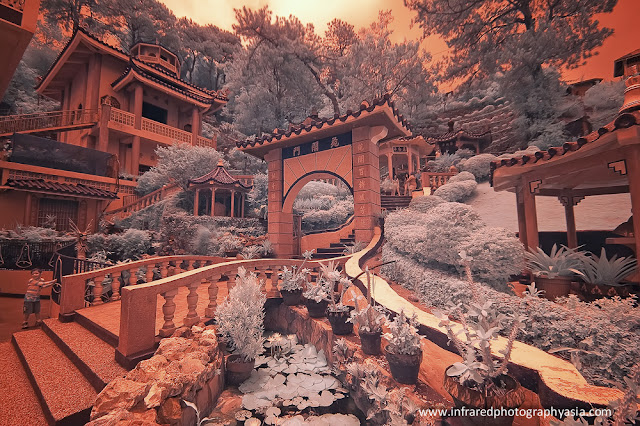
Less is more. A simpler image can become more pleasing when composing your photographs. The next infrared shot of one of the structures from the photo above exhibits this. Yes, there are still other elements present but they do not overpower the shrine which acts as the main subject. Furthermore, the trees, the other buildings and the patterns of the stairs all work together to make the main subject more visible to the viewer.
You can also create an engaging image by combing a vertical perspective together with a wide angle shot. Ideally, when seen as a whole, a vertical image usually grips the viewer from a point of interest (such as the design of the brick pathway in the photo below) towards the rest of the frame.
In this second vertical image, the octagon pond on the lower half of the frame is the point of interest, acting as a foreground to lead the eye towards the rest of the image.
All these images were taken with a 10-20 millimeter Sigma Lens for cropped sensor body (Dx) and a Nikon D70s/D70 body converted to 'Enhance Color IR'.
Wednesday, December 14, 2011
Break Time
I was early for a prenuptial session shoot with one of my photo mentors when walking around and shooting some images for infrared photography came to mind to put valuable time into good use. Knowing I would have to come back to be in time for the pre-nuptial session, I decided to use an ‘infrared digital camera’ owned and self-converted by another mentor.
The next half-hour was not put to a waste but proved to be very productive instead . I clicked a few shots until I came to a certain spot. It was just a few minutes past mid-noon and the light was perfect for infrared photography. There was one particular image I loved.
The colors of the foliage were outstanding due to the heat and the light of the midday sun. I was very happy with the outcome but I know there might be a way to improve it.
Nikon D70 (converted camera) with an 18-55 kitlens, f/9, 1/500s., ISO 400 12:49 p.m. (Click on image to enlarge)
I had enough and started walking back to the assembly for the afternoon photo session.
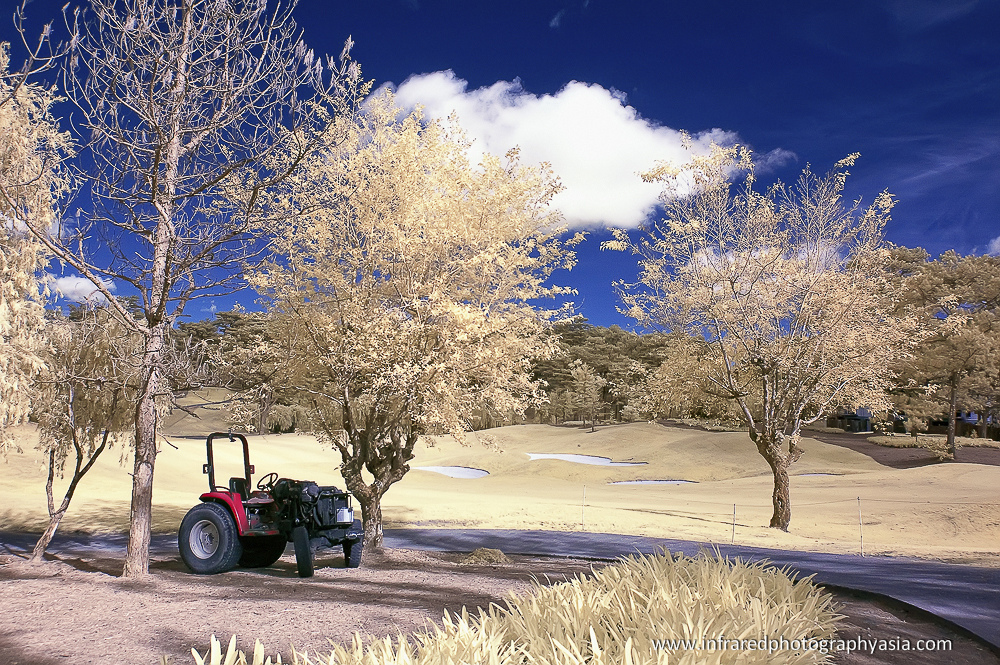
We spent almost an hour and a half shooting the engagement session when we past by the same spot where I was shooting for infrared previously! The light was not that bright and it was almost three in the afternoon. However, I noticed that there was this tractor beneath one of the trees. I immediately grabbed the converted camera again and got a frame.
The colors were not very striking but I suppose this second shot of the same place might be more effective with the tractor. Upon arriving home later, I started processing the images and indeed, the second image with a tractor proved to be more appealing, at least for me.
Break Time.Nikon D70 (converted) with an 18-55 kitlens, f/7.1, 1/800s., ISO 400 2:41 p.m. (Click on image to enlarge)
More often than not, you need to go back to a certain place several times (for some, in a span of months or years) until you get the shot you need.
Subscribe to:
Posts (Atom)